
First things first: if you don’t know what SEO is, read this article first. In this article we’re going to explore the importance of getting your SEO fundamentals right.
We’re going into a bit more detail about SEO fundamentals & concepts in this article so you kinda need to know what SEO is.
If you’re clued up on SEO basics and have come to the strikingly obvious realisation that it’s something you must be doing – good job.
Glad to have you here.
So let’s get started – what are your SEO fundamentals? Why are they important? And how do you get them right?
Let’s dive in and find out.
SEO basics: #1 Research
1. Competitor research
Keep your friends near, but keep your SEO competitors so close you need to wear a facemask.
See, SEO is a game of chess.
Everyone is scrambling over one another to climb to Google’s top spots. That profitable place where the top three results get 75% of all clicks (Backlinko).
You’re competing. There are no two ways about it.
The first step in this process is identifying who is taking leads (or website traffic) that could be yours.
These competitors can usually be split into two camps: Local SEO and Worldwide SEO.
Example – Say you own a coffee shop in Stoke-on-Trent. You’re not in competition with coffee shops in Glasgow or Paris, are you? Your SEO competitors are other coffee shops in Stoke. This is local SEO and the goal here is to appear top of this section in Google:
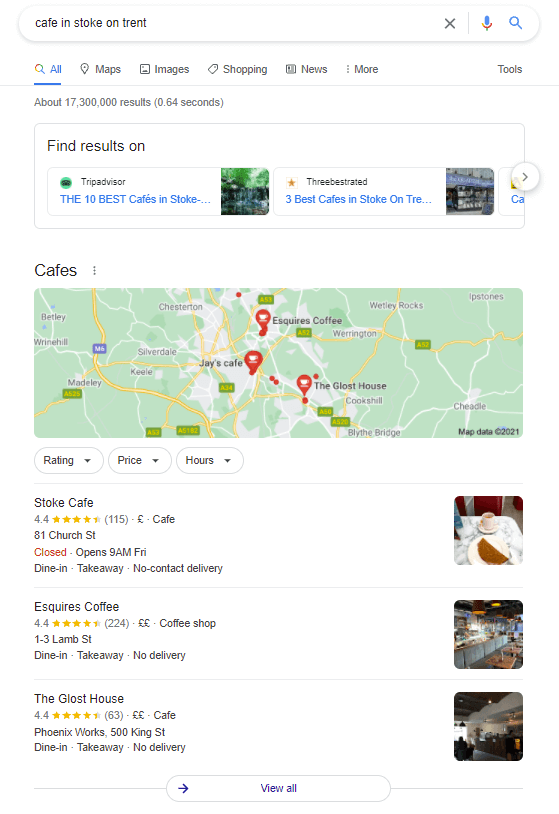
Now say you decide to roast your own coffee beans and you want to sell these online. Suddenly, your competition is coffee roasters all over the UK (and maybe the world). This is where your worldwide SEO kicks in.
You’ve got to know both your local SEO competitors and your worldwide SEO competitors.
Once you’ve identified them, you need to analyse them. Specifically:
– What keywords they’re ranking for
– What kind of content they’re posting
– How active they are on social media
– How their website is laid out
– Their site speed
– How often they update their content
Only once you understand all of this will you be able to copy what they’re doing well and take advantage of what they’re doing poorly (or not doing at all).
In terms of absolute SEO basics, this is number one.
2. Keywords
Next, you need to know what people are searching for.
Quick note – keywords don’t have to be one word. Take this article you’re reading now. Our main keyword is ‘SEO basics’ so you’ll notice we drop it in here and there.
Right, now you’ll have a starting list of keywords because of your competitor analysis, but you can’t stop here. Who’s to say they’ve done it properly?
You need to do your own.
Here’s how to do that.
Keywords research tools
Websites like Ahrefs and SEMrush are the industry leaders in this respect, but they can be expensive and difficult to learn if you’re getting to grips with SEO basics.
A far easier tool to use is Keywords Everywhere. This Chrome extension is cheap, easy to use, and gives you digestible data to find the best keywords.
The next thing to understand is keyword search volume and keyword competition.
Keyword search volume
This is how many people search for this keyword (or key phrase) per month.
When you’re doing keyword research, the more keyword search volume a keyword has – you’d think the better it is, right?
Wrong. See, naturally, other people have noted which keywords have the highest search volume so they’re trying to rank for those keywords too.
This is called keyword competition.
This can be your worst enemy and your best friend.
Keyword competition and long tail keywords
If you’re trying to rank for keywords that big businesses with deep pockets are dominating, you’re usually best looking for keywords with smaller competition.
Often, if you add up the keyword search volume of all of the less popular search terms, this will come close to the one keyword everyone is trying to fight for.
These less popular search terms are called long tail keywords.
Finding these long tail keywords and ranking for them means anyone (yes, you) has a chance of ranking on Google and enjoying the leads that come with that.

SEO Basics: #2 Content
Now you’ve got all these keywords, what are you going to do with them?
If you identify 20 long tail keywords you want to rank for, you can’t stuff them all into the words on your Home, About and Services pages. It’ll make you sound weird.
The best way to use keywords to improve your Google ranking is to create genuinely helpful resources that your target customer will find valuable.
Take this blog again as an example. Yes, we’re writing it with our keywords in mind but most of all, we’re writing it to help you get to grips with SEO basics and SEO fundamentals & concepts.
Write helpful articles that give your target audience the information they’re searching for. Information genuinely written to help them.
And write them as if you’re talking to a friend – not like you’re trying to stuff as many keywords into your article as possible.
Prioritise people first and Google’s bots second and Google will reward you.
SEO Basics: #3 Link building and citations
Backlinks
A backlink is when someone else’s website links to your website.
If lots of good websites link to yours, Google thinks: ‘hey, this resource must be good’ and will reward you with a better ranking.
If you’re thinking ‘there must be somewhere I can buy backlinks’, you’re right. But that doesn’t work in 2021.
See, you need backlinks from websites that are relevant to your industry. So how do you get those? You build relationships with the people who control the content on that site.
That’s why we like to think of ‘link building’ more as ‘relationship building’. You need to get to know these people.
This is how you ‘do backlinking’ in 2021.
Citations
Making sure you’re on the right citation websites is one SEO basic you must tick off.
Citation websites are like an online yellow pages directory.
The more citation websites you’re on, the more arrows you have pointed to your business.
SEO Basics: #4 Technical SEO
The next of the SEO fundamentals we need to look at is technical SEO.
This is all of the ‘behind the scenes’ work that, unless you have a good understanding of website design and website development, you’ll need a hand with.
We break technical SEO down into three areas:
- User experience
- Site speed
- On-page and off-page SEO
Let’s start with user experience (UX).
User Experience
How easy your website is to use directly impacts your SEO ranking.
Why? Because the websites Google recommends first to you are what it deems to be the best websites. And the best websites, naturally, are easy to use.
Plus! Google tracks user behaviour on your website. So if someone lands on your website, takes one look at it and thinks ‘nope’, Google sees that they’ve closed it quickly and without visiting more than one page.
This, again, affects your SEO ranking.
Site speed
39% of people wouldn’t use a slow website ever again (Hubspot).
If this isn’t enough to make you realise you need to improve yours, along with user experience, your site speed has a big impact on your SEO ranking.
We go into detail about site speed in this article.
Slow websites = bad websites.
Bad websites = lower ranking.
On-page & off-page SEO
Meta tags. Meta descriptions. Keyword placement. Keyword density. Alt tags. Image loading times…
There’s a lot to consider with SEO aside from the words and images you see on screen.
Often business owners forget about this crucial step because it’s out of sight, out of mind. But it makes a huge difference to your SEO ranking and is very important.
What you need to do next
We’ve covered a lot in this article, but it’s not for good reason.
Getting your SEO basics and SEO fundamentals right is as important in 2021 as it’s ever been and the harsh reality is you can only do so much yourself.
See, Google ranks your website based on a lot of things. So If you put a lot of effort into (for example) content but your research and technical SEO are poor, you’re wasting your time. Everything has to work in synergy.
White Digital (that’s us) is one of the UK’s leading SEO agencies. We have a track record in driving traffic to our client’s websites using all of the ways we’ve described above.
Click here to learn how we increased traffic by 24% to AVL’s website.
Then email kathy@staging.white.digital to book a chat to learn how we can help you.